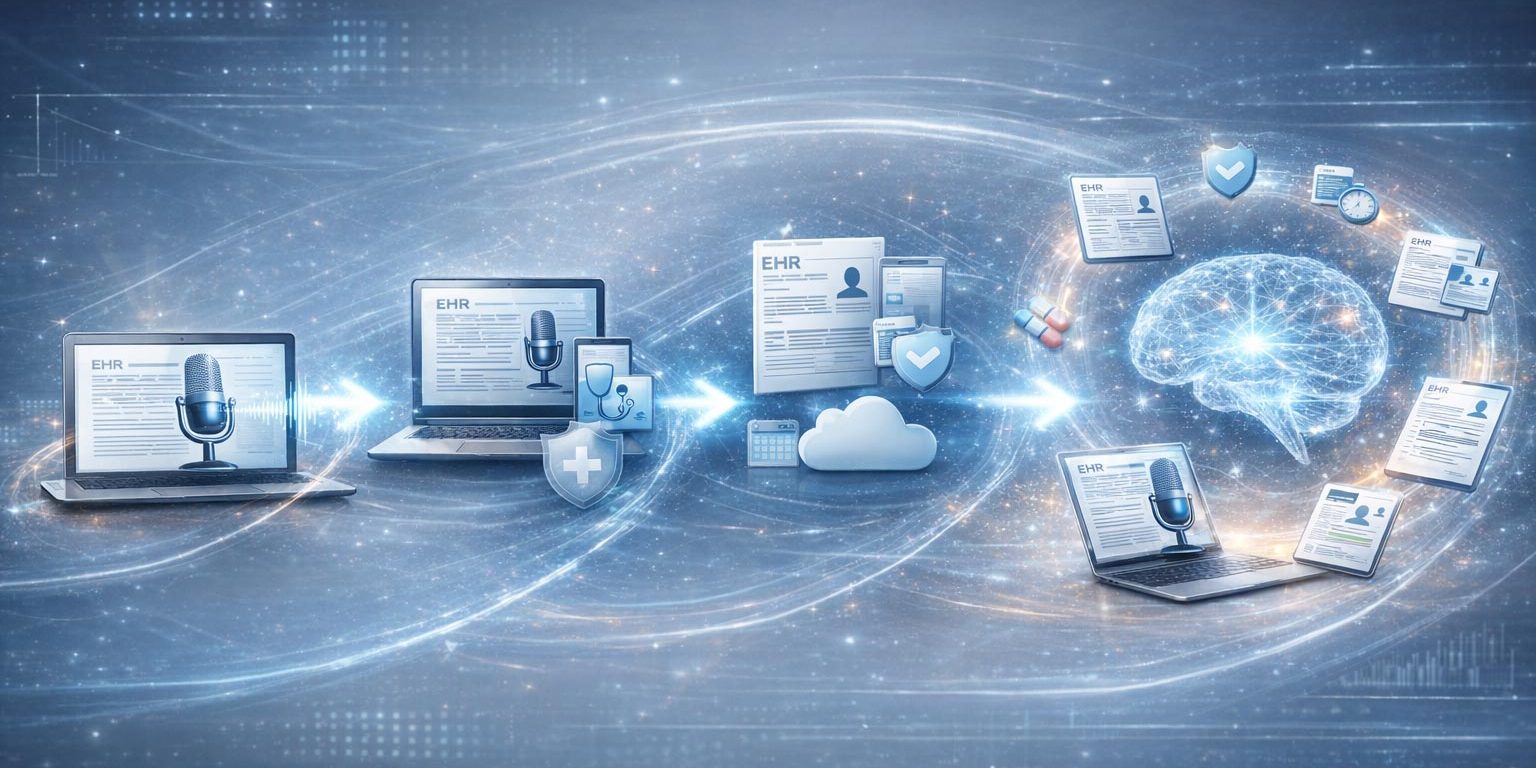
Speech recognition in healthcare has come a long way. What started as simple dictation software has evolved into intelligent systems that understand context, automate documentation, and support clinical workflows in real time.
If you’ve used Dragon products over the years, you’ve seen this transformation firsthand. And if you’re new to the ecosystem, understanding this evolution helps explain why Microsoft Dragon® Copilot represents such a major leap forward.
Let’s take a look at how we got here.
The Early Days: Basic Dictation
The first generation of Dragon software focused on one thing. Converting speech into text.
Tools like Dragon® NaturallySpeaking allowed users to dictate instead of type. This was a major improvement in speed and efficiency, especially for professionals dealing with large amounts of documentation.
However, these early systems had limitations:
- Required voice training
- Limited accuracy
- No understanding of clinical context
- No integration with workflows
It was faster than typing, but still very manual.
Dragon Medical: Built for Clinical Use
As healthcare needs became more complex, speech recognition evolved. Dragon Medical introduced a more specialized approach designed specifically for clinical environments.
With Dragon® Medical Practice Edition, providers gained:
- Medical vocabulary and terminology
- Improved accuracy for clinical dictation
- Integration with EHR systems
- Faster documentation workflows
This was a significant step forward. Clinicians could now dictate directly into patient records with greater confidence.
But documentation was still a hands-on process. Providers still had to:
- Structure notes
- Navigate fields
- Edit and format content
The burden was reduced, but not eliminated.

Dragon Medical One: The Move to the Cloud
The next major shift came with Dragon Medical One.
By moving speech recognition to the cloud, Dragon Medical One introduced:
- Consistent performance across devices
- No need for local installations
- Continuous updates and improvements
- High accuracy without voice training
- Specialty vocabularies for Veterinarians and Dentists
Providers could now log in anywhere and start dictating immediately.
Dragon Medical One also introduced more powerful:
- Voice commands
- Auto-texts
- Workflow customization
This dramatically improved efficiency. But the workflow still relied on active dictation and manual interaction.

DAX Copilot: Ambient Documentation Begins
Then came a major breakthrough. DAX Copilot introduced ambient AI.
Instead of dictating notes manually, DAX could:
- Listen to patient conversations
- Capture key clinical details
- Generate structured notes automatically
This changed the role of documentation entirely.
Clinicians no longer had to narrate everything. They could focus on the patient while the system handled note creation in the background.
Still, DAX operated as a separate experience from traditional dictation workflows.
Microsoft Dragon® Copilot: The AI Workspace Era
Now we arrive at Dragon Copilot.
This is not just the next version of Dragon. It is a complete shift in how clinical documentation works.
Dragon Copilot combines:
- The voice recognition of Dragon Medical One
- The ambient listening of DAX Copilot
- Generative AI to structure and refine documentation
The result is a unified, intelligent workspace that supports clinicians at every step.
With Dragon Copilot, you can:
- Capture full patient encounters automatically
- Generate specialty-specific notes
- Retrieve patient data using natural language
- Create referral letters and summaries instantly
- Work across devices and care settings
It is no longer about dictating faster.
It is about documenting smarter.
What This Evolution Means for Clinicians
Each stage in Dragon’s evolution has reduced the burden of documentation.
- Dictation replaced typing
- Medical-specific tools improved accuracy
- Cloud technology increased flexibility
- Ambient AI removed manual input
- AI workspaces now automate the entire process
For clinicians, this means:
- Less time charting
- Less cognitive load
- Fewer errors
- More time with patients
And for organizations, it means:
- Improved efficiency
- Better documentation quality
- Stronger financial performance
Why Many Providers Are Making the Shift Now
If you are still using traditional dictation or even standard Dragon workflows, you may be experiencing:
- Ongoing after-hours charting
- Manual editing and formatting
- Workflow interruptions
- Documentation fatigue
Dragon Copilot addresses all of these challenges by combining everything into a single, intelligent system.
It builds on what you already know, but removes the parts that slow you down.
The Role of the Right Support Partner
Technology alone does not guarantee success.
To get the most out of Dragon Copilot, you need:
- Proper setup
- EHR integration
- Workflow customization
- Training tailored to your specialty
The Dragon People specialize in exactly that.
We help clinicians and organizations transition from traditional dictation to AI-powered documentation with confidence. From onboarding to optimization, our team ensures your system works the way you need it to.
The Bottom Line
Speech recognition has evolved from simple dictation into intelligent clinical support.
Dragon Copilot represents the next step. It brings together everything that worked in the past and enhances it with AI that understands, organizes, and automates documentation.
If you are ready to move beyond dictation and into a smarter way of working, now is the time to explore what Dragon Copilot can do.